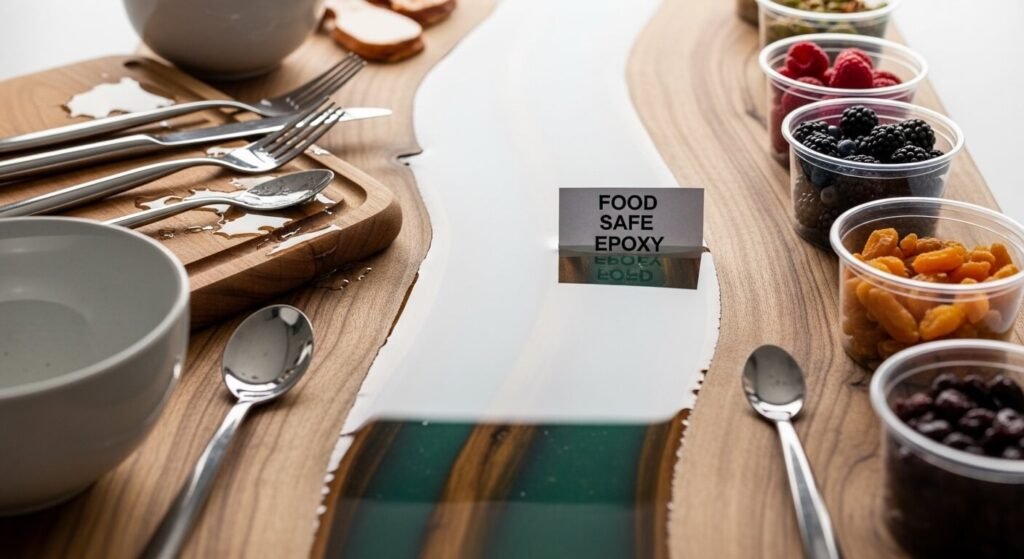

Many people want to create beautiful kitchen countertops, cutting boards, and DIY resin projects, but they worry about safety. The biggest problem is not knowing whether resin is safe for food contact, which leads to confusion and fear of using epoxy incorrectly. The simple solution is understanding how food safe epoxy works, when it becomes safe, and how to apply it correctly so it does not release harmful chemicals. With the right knowledge, you can safely use epoxy for home and kitchen projects without risk.
What Is Food Safe Epoxy?
Food safe epoxy is a special type of resin that becomes safe for indirect food contact after it is fully cured. Epoxy is made by mixing two parts: resin and hardener. When these two components mix, they create a strong chemical reaction that hardens into a solid, plastic-like surface.
Once cured properly, this surface becomes:
- Non-toxic
- Strong and durable
- Water-resistant
- Smooth and glossy
This is why it is commonly used on tables, countertops, and wooden kitchen items.
Is Epoxy Safe for Food Contact?
A common question is is epoxy safe for food contact. The answer is: it depends on curing.
Epoxy is NOT safe when it is still wet or partially cured. However, when it is fully cured according to manufacturer instructions, it becomes stable and safe for indirect contact.
Key safety points include:
- Only fully cured epoxy is considered safe
- Poor mixing can make epoxy unsafe
- Not all epoxy brands are suitable for food use
So, proper product selection and curing time are very important.
Food Safe Epoxy Resin Explained
Food safe epoxy resin is designed specifically for surfaces that may come into contact with food indirectly. It is often used by woodworkers, resin artists, and kitchen designers.
This type of resin is used for:
- Kitchen countertops
- Wooden cutting boards
- Serving trays
- Dining tables
- Bar tops
It creates a protective layer that seals wood and prevents moisture damage.
Best Food Safe Epoxy for Kitchen Projects
Choosing the best food safe epoxy is important for both safety and durability.
A good epoxy should have:
- Strong bonding strength
- Heat resistance
- Scratch resistance
- Clear curing instructions
- Safe certification for food-contact surfaces
High-quality epoxy ensures long-lasting protection and a professional finish for kitchen surfaces.
Food Safe Epoxy for Countertops
One of the most popular uses is food safe epoxy for countertops. Many homeowners use epoxy to create modern, glossy kitchen surfaces.
Benefits include:
- Waterproof protection
- Smooth finish
- Easy cleaning
- Modern design look
- Long-lasting durability
However, it is important not to cut directly on epoxy surfaces unless the manufacturer clearly allows it.
How Food Safe Epoxy Works
To understand food safe epoxy, it is important to know how it works after mixing.
- Resin and hardener are combined
- A chemical reaction begins
- The mixture slowly hardens
- After full curing, it becomes solid and stable
This curing process is what makes epoxy safe for indirect food contact.
Step-by-Step Application Guide
Using epoxy correctly is very important for safety and quality results.
Step 1: Clean the Surface
Remove dust, oil, and dirt before starting.
Step 2: Mix Properly
Follow the exact mixing ratio provided by the manufacturer.
Step 3: Apply Evenly
Spread epoxy slowly over the surface.
Step 4: Remove Air Bubbles
Use a heat gun to remove trapped air bubbles.
Step 5: Let It Cure
Allow full curing time (usually 24–72 hours or more).
Never use the surface before it is fully cured.
Safety Tips When Using Epoxy
Even though food safe epoxy becomes safe after curing, liquid epoxy must be handled carefully.
Important safety tips include:
- Work in a ventilated area
- Wear gloves
- Avoid skin contact
- Do not inhale fumes
- Follow instructions carefully
These steps protect you during the application process.
Common Mistakes to Avoid
Many beginners make mistakes when using epoxy. Avoid these to get safe and strong results:
- Incorrect mixing ratio
- Not waiting for full curing
- Applying too thick layers
- Working in cold temperatures
- Using non-food-grade epoxy for kitchen items
Avoiding these mistakes ensures better performance and safety.
How Long Does Food Safe Epoxy Take to Cure?
Curing time depends on the product and environment.
Typical curing stages:
- 24 hours → surface becomes hard
- 48–72 hours → safe for light use
- 5–7 days → full strength achieved
Patience is important to ensure the epoxy is fully safe and durable.
Benefits of Using Food Safe Epoxy
Using food safe epoxy provides many advantages:
- Strong protection for surfaces
- Waterproof sealing
- Attractive glossy finish
- Long-lasting durability
- Easy maintenance
These benefits make it a popular choice for kitchen and DIY projects.
Final Thoughts
Understanding food safe epoxy helps you safely use resin for kitchen and DIY projects. Many people ask is epoxy safe for food contact, and the answer is yes—only after full curing and correct application. High-quality food safe epoxy resin offers durability, beauty, and protection for many surfaces. Choosing the best food safe epoxy and using it properly ensures safe and long-lasting results. Whether you are working on crafts or food safe epoxy for countertops, following proper steps is the key to success.
For reservations and additional information, visit : candizi.net